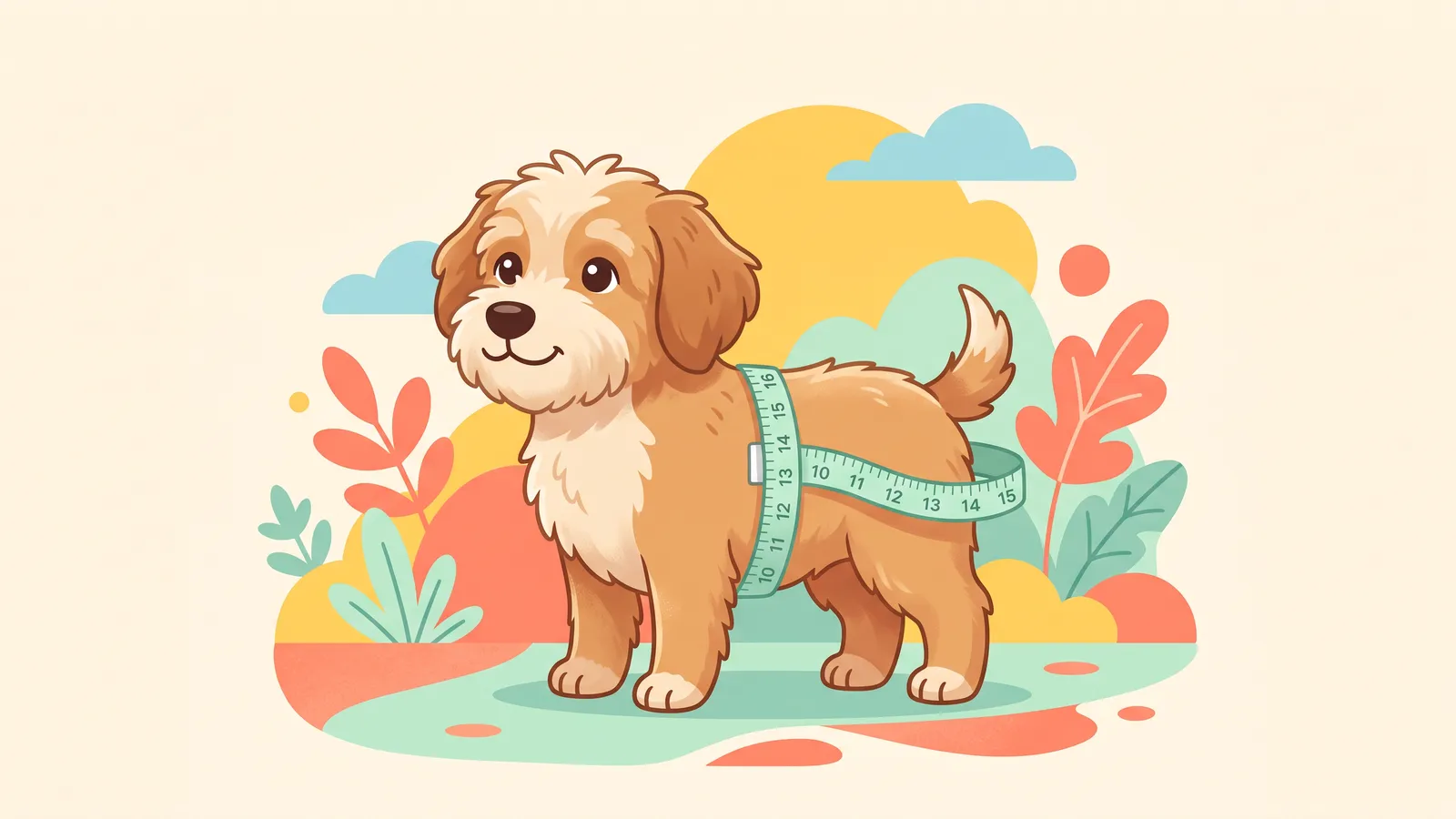
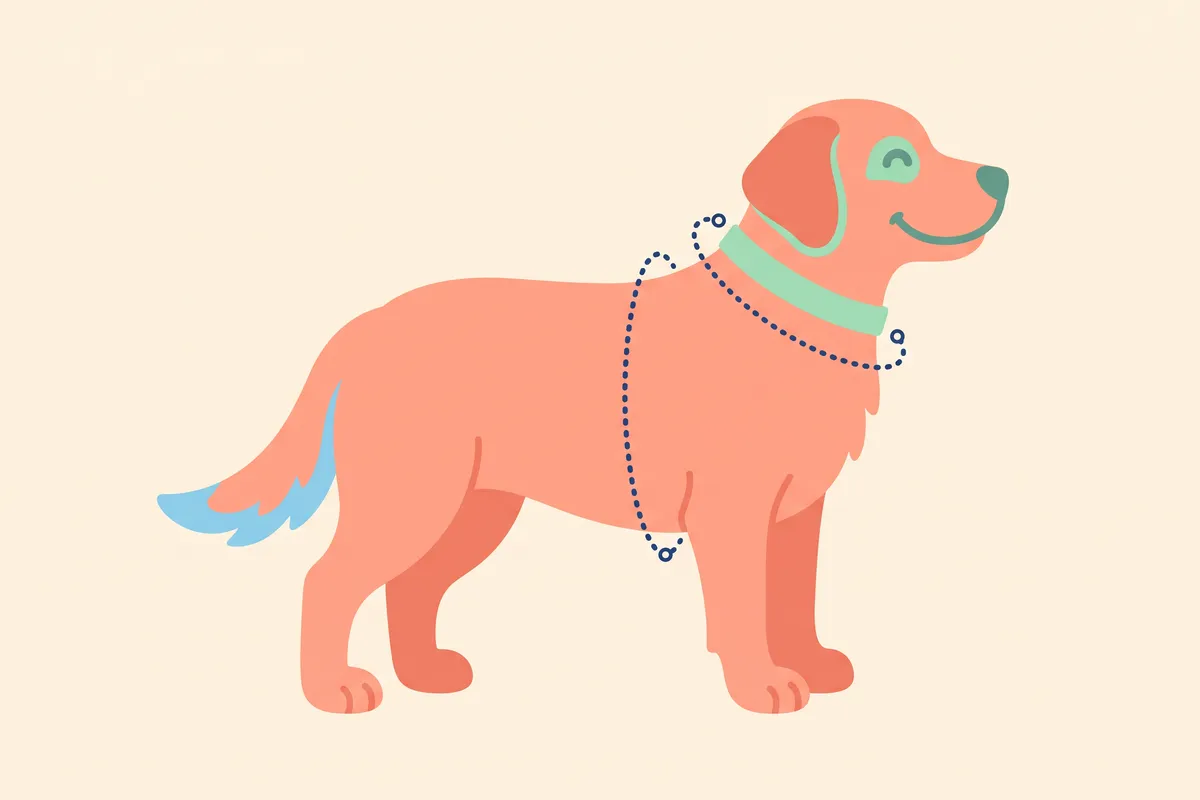
Measure your dog's chest girth: wrap a soft tape around the widest part of the ribcage, just behind the front legs, while your dog stands. Many brands also want the lower neck, measured where the harness sits, not up where a collar goes. Match those numbers to the brand's own chart, and if you're between sizes, go up.
Harness sizes aren't standard. A "Small" in one brand covers a 15-inch chest and in another starts at 22 inches. That's why weight and breed are only rough guides, and why two minutes with a tape measure saves a return.
How to measure your dog for a harness
What you need: a soft sewing tape measure, treats, and ideally a helper. No soft tape? Use a piece of string or a phone cable, mark it with your fingers, and lay it against a ruler.
1. Stand your dog square
Your dog should stand naturally on a flat floor, head up, weight on all four feet. rabbitgoo's guide starts the same way. A sitting or curled-up dog gives a smaller chest number.
2. Measure the chest girth
Wrap the tape around the widest, deepest part of the ribcage, just behind the front legs. On a deep-chested dog it can sit a couple of inches further back. This is the number every brand uses: Ruffwear sizes its Front Range on girth alone.
- Keep the tape snug but flat. It should sit on the coat, not squash it.
- On a fluffy dog, press the tape gently through the fur so you're measuring the dog, not the coat.
- Take it twice. If the numbers differ, use the larger one.
3. Measure the lower neck
Measure around the neck where the harness neckline will sit, low near the shoulders. rabbitgoo says not to measure "high at the collar line". This matters for overhead harnesses and for broad-necked dogs like Frenchies.
4. Note the back length if your dog is long
For a dachshund, corgi or basset, measure along the spine from the base of the neck to the base of the tail. Few harness charts use it, but it tells you whether you need a harness with an adjustable back strap.
5. Write it all down, and the weight too
Weight is the last thing to check, not the first. PetSafe calls its weight ranges "only approximate", and rabbitgoo says: "Do not select a size from weight alone."
Dog harness size chart: four brands side by side
Take your girth measurement and read across. Each brand's own chest ranges are listed underneath.
| Chest girth | Ruffwear Front Range | PetSafe Easy Walk | rabbitgoo ControlPro* | Julius-K9 IDC |
|---|---|---|---|---|
| 14 in | XXS | Petite or Petite/Small | XS | Below Mini-Mini: see chart |
| 18 in | XS | Petite/Small or Small | XS | Mini-Mini |
| 22 in | XS or S (on the line) | Small/Medium or Medium | S | Mini |
| 26 in | S | Medium | M | Mini or Size 0 |
| 30 in | M | Medium | L | Size 0 (at the top) |
| 34 in | L/XL | Medium/Large or Large | XL | Larger size: see chart |
| 38 in | L/XL | Large | XL (at the top) | Larger size: see chart |
| Brand | Size: chest girth |
|---|---|
| Ruffwear Front Range | XXS 13–17 in · XS 17–22 in · S 22–27 in · M 27–32 in · L/XL 32–42 in |
| PetSafe Easy Walk | Petite 12–17 · Petite/Small 13–18 · Small 15–21 · Small/Medium 19–26 · Medium 22–32 · Medium/Large 24–34 · Large 27–40 · XL 32–49 in |
| rabbitgoo ControlPro | XS 11.6–18.5 · S 13–23.5 · M 15–27.8 · L 17–33.4 · XL 21–38 in (neck: XS 10.2–13.5 · S 13–18.5 · M 16–21.8 · L 18–25.8 · XL 23–35 in) |
| Julius-K9 IDC Powerharness | Mini-Mini 15.5–21 in · Mini 19.5–26.5 in · Size 0 23–30 in |
Our data. Method: we copied each brand's chest (and, for rabbitgoo, neck) ranges from its own size chart. Ruffwear, PetSafe and rabbitgoo were read on October 10, 2026; the Julius-K9 ranges come from Julius-K9 Canada's IDC chart, read for our French bulldog harness guide on October 7, 2026. Where two sizes cover a girth, we list the smaller one unless the girth is at its very top. *rabbitgoo's chest ranges overlap a lot, so check your dog's neck against its neck range too.
What the chart shows:
- The same dog is a different "size" in every brand. A 22-inch chest is an XS-to-S in Ruffwear, a Small/Medium in PetSafe, an S in rabbitgoo and a Mini in Julius-K9.
- Boundaries are common. Ruffwear and PetSafe both say to size up when you're between sizes. Most harnesses adjust down more easily than they stretch.
Starting sizes for 10 breeds
If you're buying before your puppy grows or the dog arrives, this gives you a ballpark. It's built from weight, so treat it as a guess until you can measure.
| Breed | AKC weight | PetSafe size by its weight guide | Girth that size covers |
|---|---|---|---|
| Chihuahua | Up to 6 lb | Petite | 12–17 in |
| Dachshund, miniature | 11 lb and under | Petite or Petite/Small | 12–18 in |
| Dachshund, standard | 16–32 lb | Small to Medium | 15–32 in |
| Poodle, toy | 4–6 lb | Petite | 12–17 in |
| Poodle, miniature | 10–15 lb | Petite/Small | 13–18 in |
| Poodle, standard | 40–70 lb | Medium to Large | 22–40 in |
| French bulldog | Under 28 lb | Small to Small/Medium | 15–26 in |
| Beagle | Under 20 lb or 20–30 lb | Small to Small/Medium | 15–26 in |
| Corgi (Pembroke) | Up to 30 lb | Small/Medium | 19–26 in |
| Golden retriever | 55–75 lb | Medium/Large or Large | 24–40 in |
| Labrador retriever | 55–80 lb | Medium/Large or Large | 24–40 in |
| German shepherd | 50–90 lb | Medium/Large or Large | 24–40 in |
| Goldendoodle | 25 lb to 51+ lb | Small to Large | 15–40 in |
Our data. Method: AKC weight ranges from our breed gear guides (goldendoodle from the GANA sizes on our goldendoodle page), matched to PetSafe's own "approximate weight" column, then read across to the girth range PetSafe gives for those sizes. Read on October 10, 2026.
The ranges are wide on purpose: that's how much dogs of one breed vary. Two notes:
- Deep-chested breeds (dachshunds, corgis) often fit the chest of one size and the back of another. A harness with an adjustable back strap, like the Blue-9 Balance, solves that. See our dachshund harness guide.
- Frenchies have broad necks. Our French bulldog harness guide has a Frenchie-only size table.
What size harness for a 40 lb dog?
By PetSafe's weight guide, a 40 lb dog sits where its Medium (25–50 lb) and Medium/Large (40–65 lb) overlap. Measure the girth: under about 32 inches points to a Medium in PetSafe and usually an M in Ruffwear's Front Range (27–32 inches).
Picking the size once you've measured
The Ruffwear Front Range is the simplest chart to use: one girth number, five sizes, from 13 to 42 inches. Treeline Review's trainer named it the best harness for small dogs, and it has a back clip plus a front loop for mild pullers.
The PetSafe Easy Walk has the widest range here, eight sizes from a 12-inch to a 49-inch chest, so it's an easy fit for very small and very big dogs. It's a front-clip harness for pullers; our stop pulling guide explains how to use one alongside training.
For a long or between-sizes dog, the Blue-9 Balance has six adjustment points, including the back strap, and runs from an XS (13.5–18 inch chest) to an L (29–43.5 inches).
How to measure a puppy for a harness
Measure the same way, but plan for growth:
- Buy an adjustable harness and start with the straps near their tightest, so there's room to let them out.
- Re-measure every couple of weeks. Puppies outgrow gear fast.
- Treeline Review's trainer says puppies "can—and should—wear harnesses", because a good fit helps protect the neck and windpipe while they grow.
How to measure a dog for a car harness
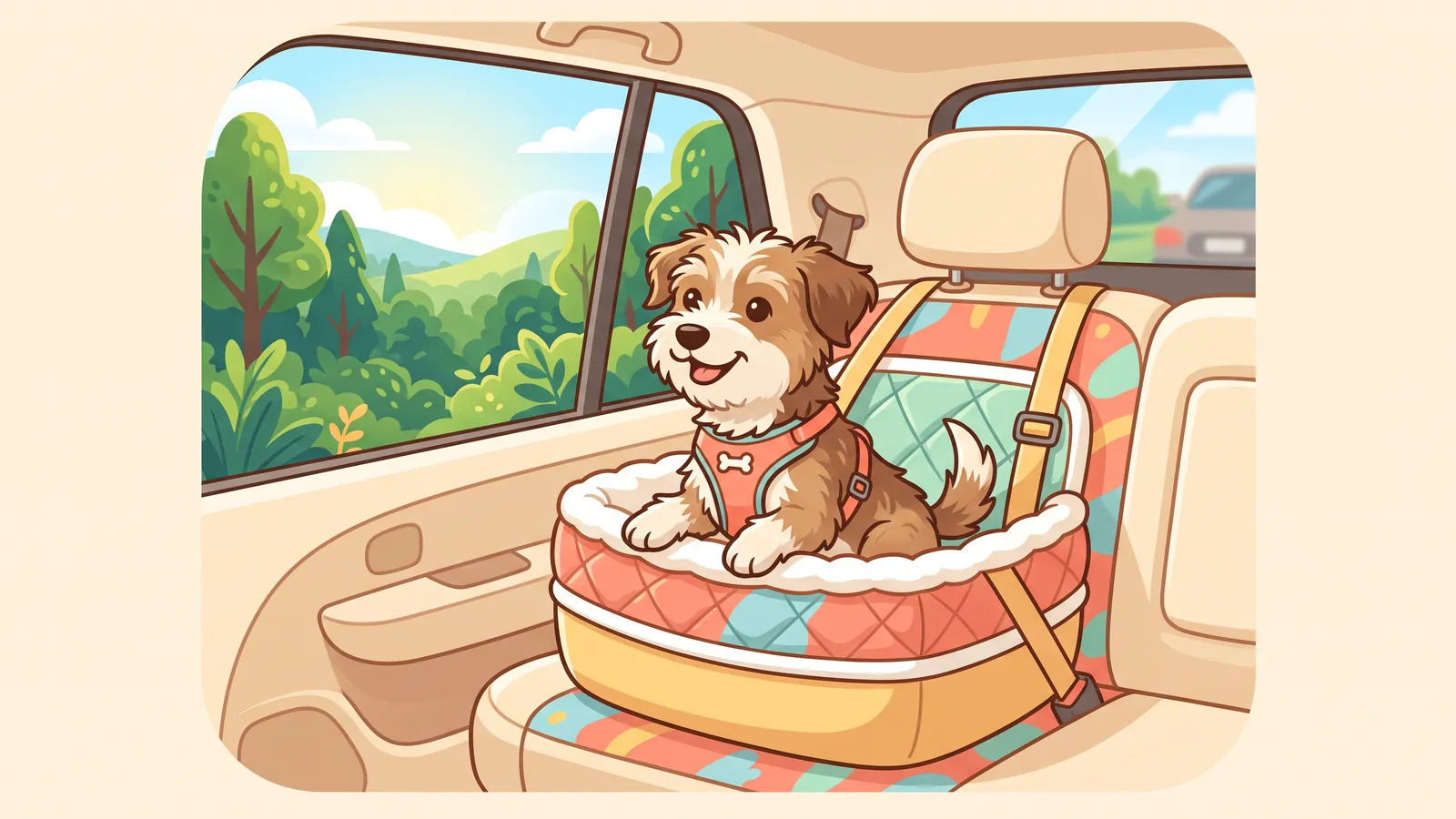
A walking harness isn't car safety gear. For the car, measure girth the same way, then check the crash-tested harness maker's own chart. The Center for Pet Safety lists the Sleepypod Clickit Sport as CPS Certified, 5 Star, in Small to X-Large, and rates each size by weight: Small to 25 lb, Medium from 45 to 90 lb. A dog between 25 and 45 lb falls in a gap, so check Sleepypod's chart and our dog car seat guide before you buy.
Check the fit once it arrives
- Two flat fingers should slide under every strap, no more. PetSafe says 1–2 fingers; rabbitgoo says about two.
- The chest piece sits on the breastbone, not across the throat.
- No rubbing in the armpits after the first few walks.
- Backing-out test: stand in front, hold the back clip and pull gently toward you. If the harness slides over the shoulders, tighten the girth strap.
Our step-by-step guide on how to put on a dog harness covers each harness style and the fit checks in detail.
FAQs
Where do you measure a dog's chest for a harness?
Around the widest part of the ribcage, just behind the front legs, with your dog standing. This is the "girth" or "chest" on almost every harness chart.
Is chest girth the same as chest width?
No. Girth is all the way around the ribcage, and it's what nearly every chart uses. A few brands, PetSafe included, also list a chest width, but girth decides the size.
Should a dog harness be tight or loose?
Snug. Two flat fingers should fit under each strap. Any looser and your dog can back out; any tighter and it will rub.
What if my dog is between harness sizes?
Go up a size and tighten the straps. Ruffwear and PetSafe both recommend sizing up.
Can I use my dog's collar size to pick a harness?
Not on its own. A collar sits high on the neck, and most harness necklines sit lower and wider. Measure the lower neck and the chest.
Grab a soft tape, stand your dog square and measure the chest twice. With that one number you can read any brand's chart.