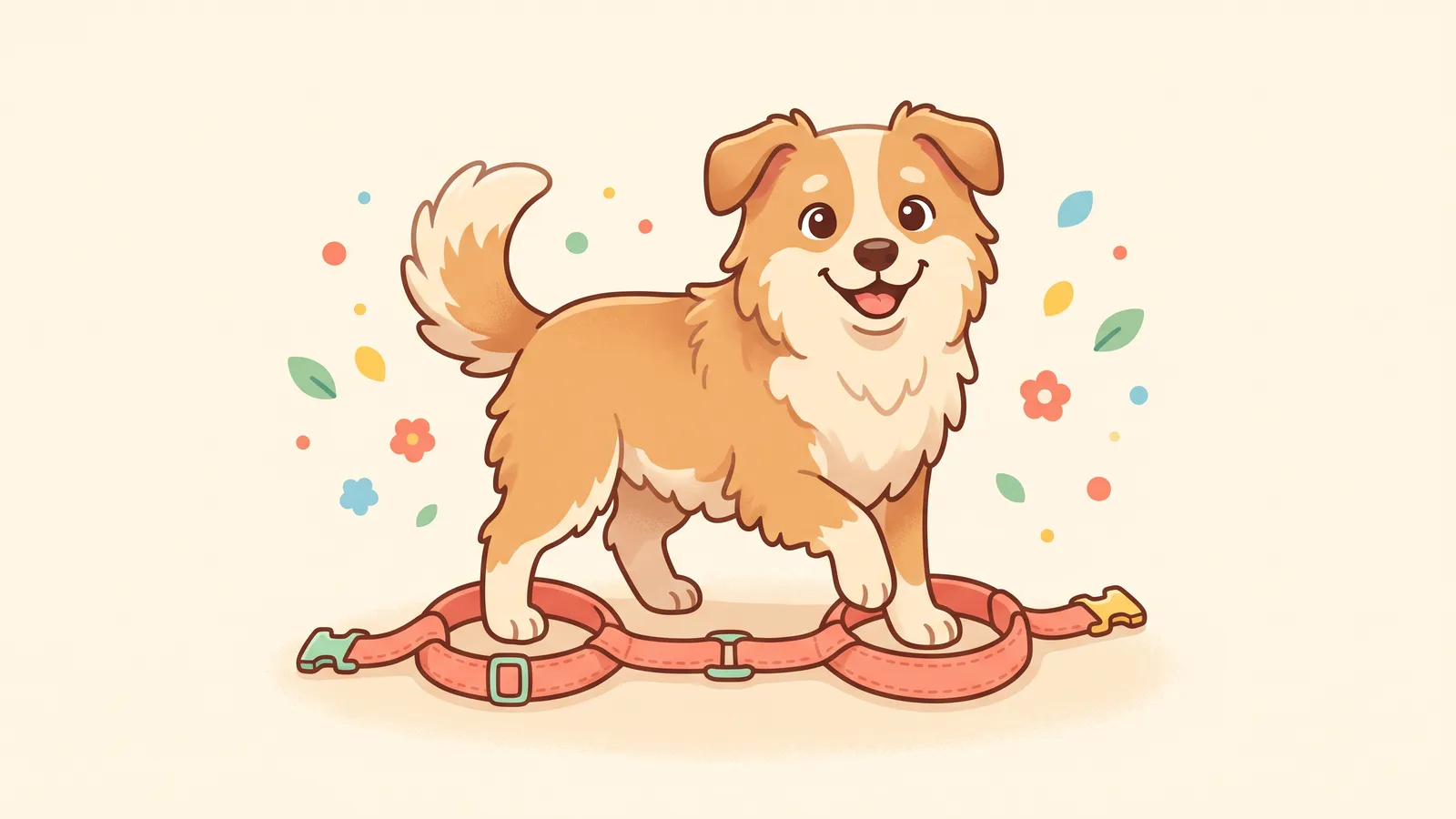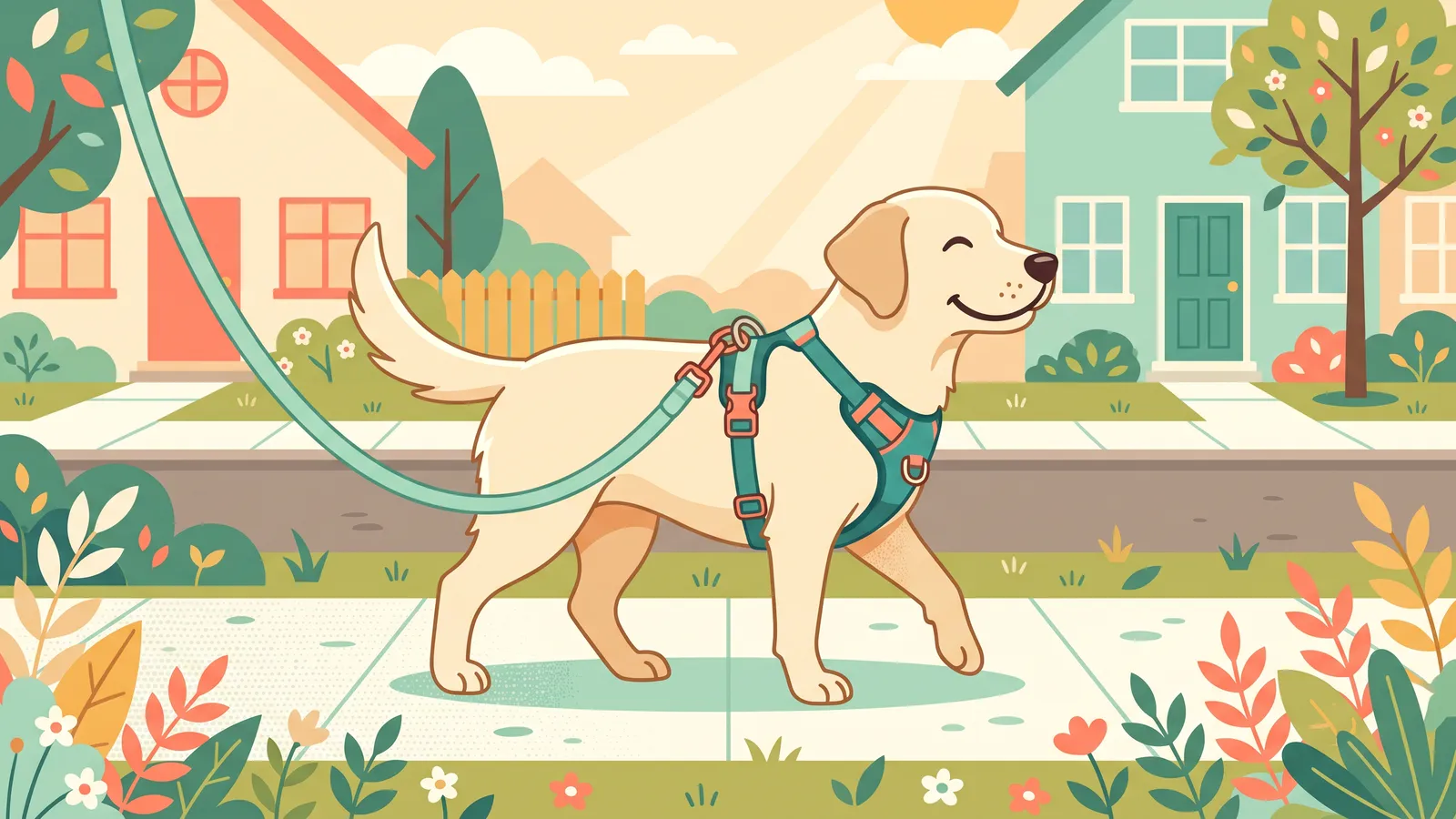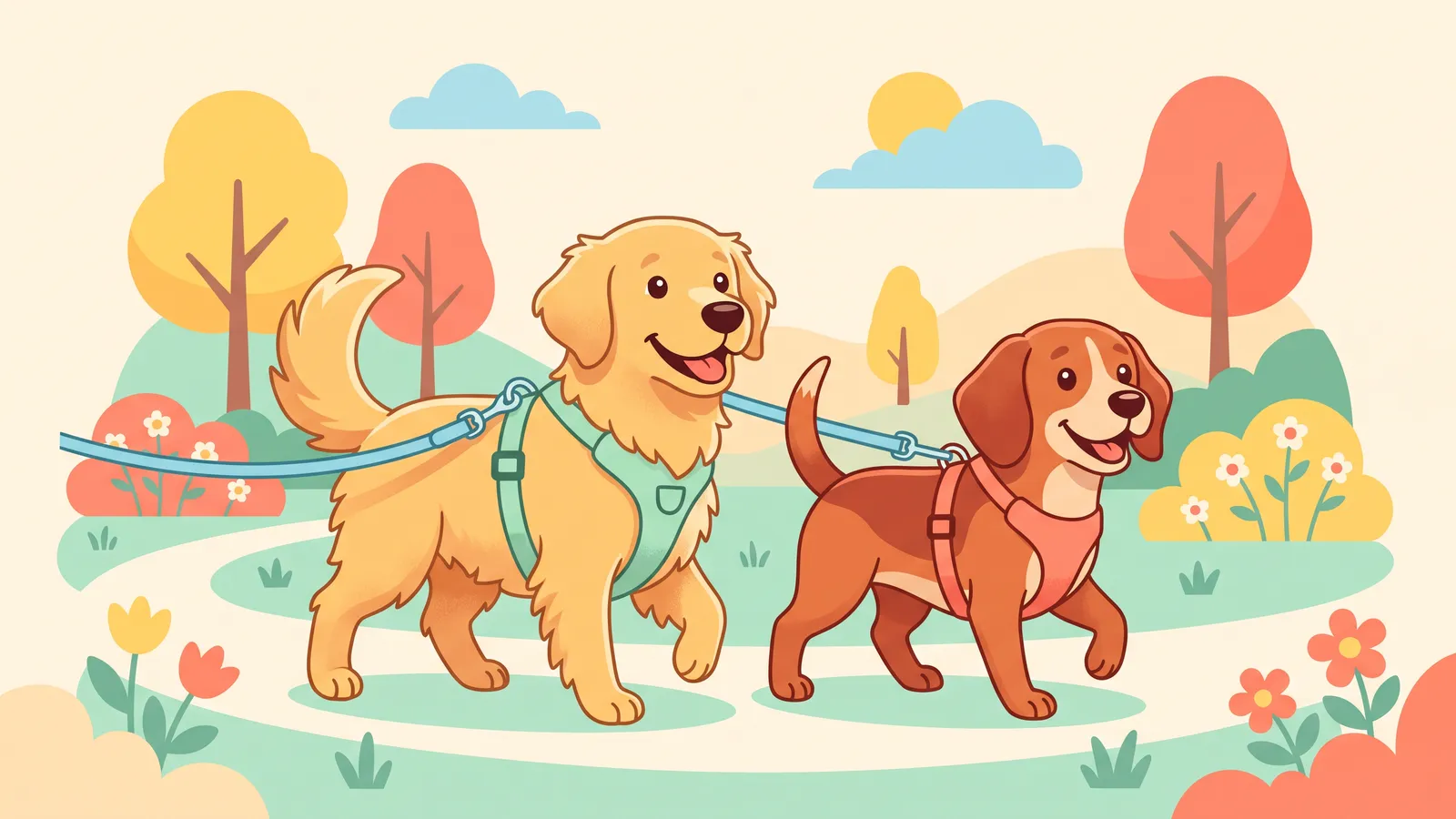
Front clip if your dog pulls; back clip if they don't. A front (chest) clip turns your dog back toward you when they lean into the leash, which makes pulling easier to manage while you train. A back clip is simpler and more comfortable for a dog that already walks on a loose leash. Many owners get a harness with both rings and switch between them.
Neither ring is "better" on its own. The right one depends on how your dog walks, their body shape and what you're doing that day. Below: what each clip does, a decision table for different dogs, and the harness design details that matter more than the ring.
What each clip does
| Front clip (on the chest) | Back clip (between the shoulder blades) | |
|---|---|---|
| When your dog pulls | The leash pulls the chest sideways, turning your dog toward you | Your dog can lean into the harness and keep going |
| Best for | Dogs who pull, training walks | Calm walkers, hikes, jogging, small dogs |
| Downsides | Can twist sideways on a dog who keeps pulling; leash can catch the front legs | Gives you little steering with a strong dog |
| Ease | Takes a little practice to handle the leash | Easiest to use; leash stays above your dog's legs |
Two points from Treeline Review's harness test, written by a certified trainer (CPDT-KA):
- "When dogs continue to pull on front clip harnesses, the harness often rotates." A front clip is a training aid, not a fix. Pair it with the stop-and-wait method in our stop pulling guide.
- "Double-ended leashes can be attached to the front and back clips to steer your dog more effectively." That's the best of both: steering from the chest, stability from the back.
Which clip for your dog? A decision table
Our data. We built this from Treeline Review's trainer-written test, Whole Dog Journal's harness reviews, PetSafe, Hepper and breed sources (read October 10, 2026). Where a row is our own judgment, it says so.
| Your dog | Use | Why | Look for |
|---|---|---|---|
| Pulls hard | Front clip, or both with a double-ended leash | Turns the dog toward you; Treeline suggests both rings for steering | A Y-front harness with front and back rings; train as you go |
| Pulls sometimes | Back clip, switch to front on busy days | Comfort most of the time, steering when you need it | Two rings, so you don't need two harnesses |
| Walks nicely | Back clip | Simplest, and the leash stays clear of the legs | A light Y-front with a back ring |
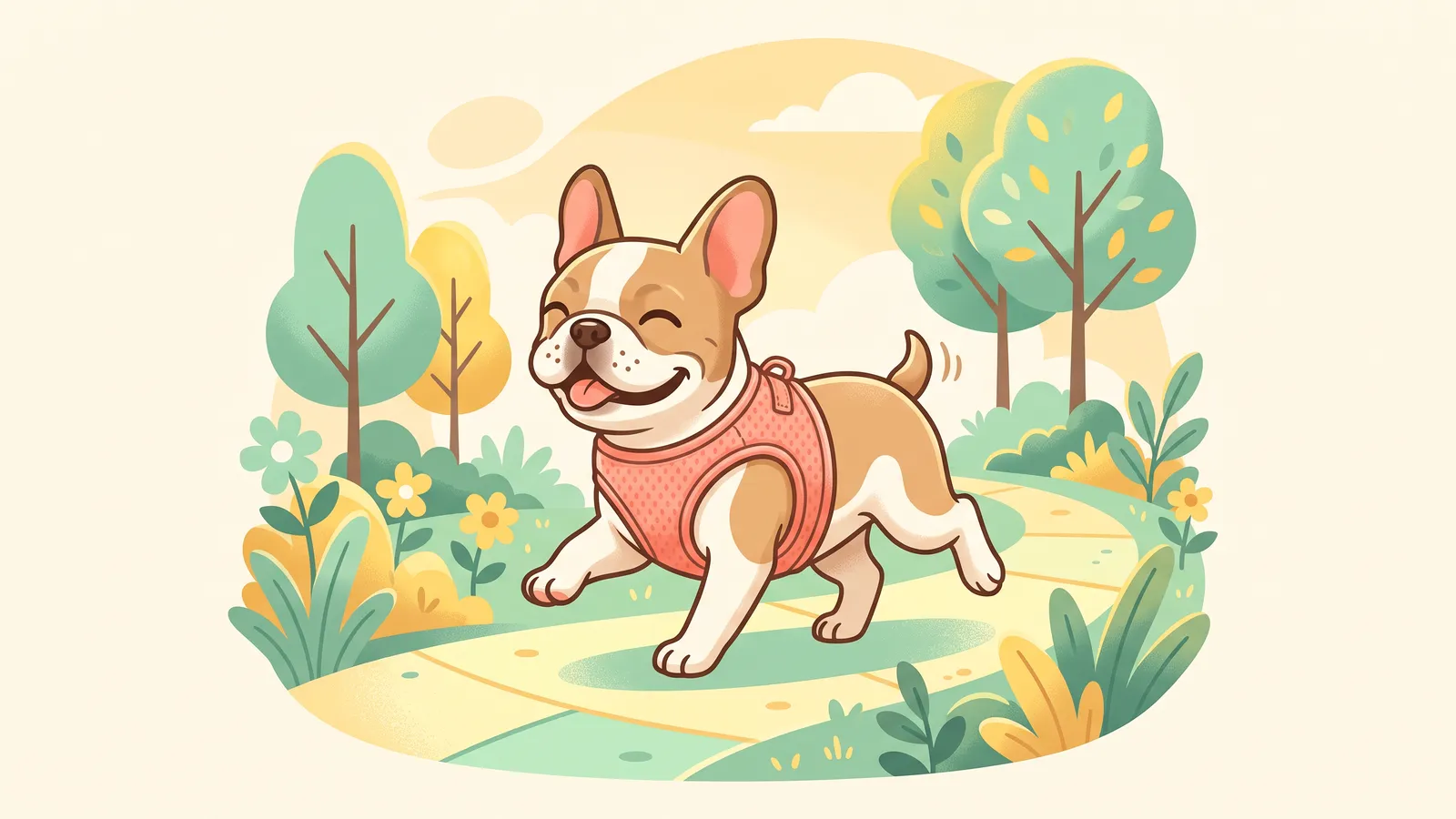
| Flat-faced (Frenchie, pug, bulldog) | Either clip, always on a harness, never a collar | Canine Journal says a collar can press on a Frenchie's windpipe, especially if they pull; Hepper says head halters aren't suited to flat-faced breeds | A harness that sits on the chest, not the throat; see our French bulldog harness picks |
| Long back (dachshund, Corgi, Basset) | Back clip for everyday walks | Our take: a front clip that twists pulls a long body sideways. Use the front ring only for short training sessions | A harness that adjusts along the back and spreads the load; see our dachshund harness picks |
| Small dog (under about 20 lb) | Back clip, mostly | Our take: on short legs, a front-clip leash hangs near the paws and tangles easily. A small dog's pulling is easier to manage from the back | Small sizes with a real fit range (XXS and XS) |
| Puppy | Back clip while learning; front clip when you start leash training | Treeline's trainer says puppies can and should wear harnesses to protect the neck and trachea | Lots of adjustment, since they grow fast |
| Hiking or jogging | Back clip | Free movement, leash out of the way | Padding and a handle for scrambles |
The design detail that matters more than the ring
How the harness crosses your dog's chest matters at least as much as where the leash clips.
- Y-front harnesses have a strap running down the breastbone between the front legs, with a V around the neck. Treeline's trainer says this leaves "the shoulders free to fully extend."
- Straps across the front of the shoulders are a different story. Treeline's trainer warns that "any harness that cuts across the front of your dog's shoulders restricts their range of motion and can cause orthopedic damage."
- Martingale no-pull harnesses like the PetSafe Easy Walk work differently. PetSafe says its martingale loop "puts gradual pressure on your dog's shoulders" when they pull. One Frenchie owner (The Frenchie Life) found it didn't restrict their dog's shoulders but noted the nylon straps can rub behind the front legs. We'd keep this style for a determined puller, used for training walks, not all day.
So the best front-clip setup is usually a Y-front harness with a front ring, rather than a strap that sits across the shoulders.
Getting the fit right (whichever clip you use)
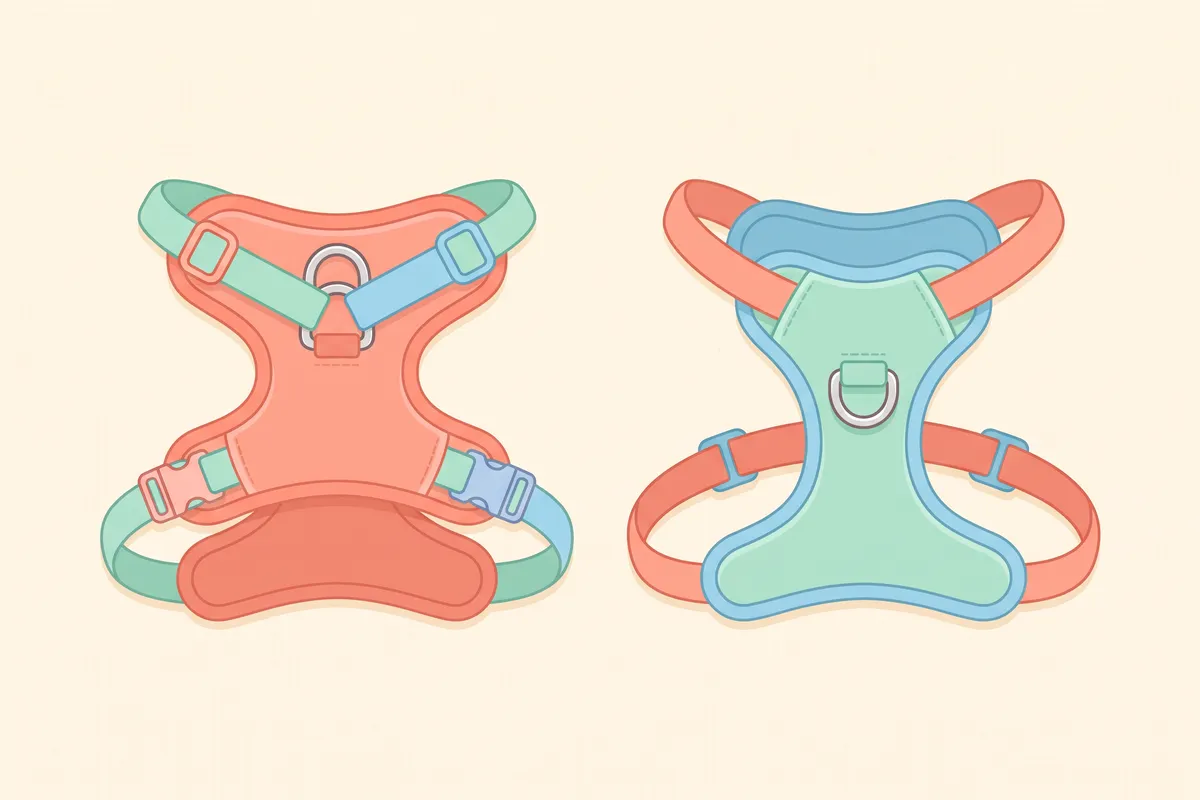
A badly fitted harness twists, rubs and lets dogs back out of it, front clip or not.
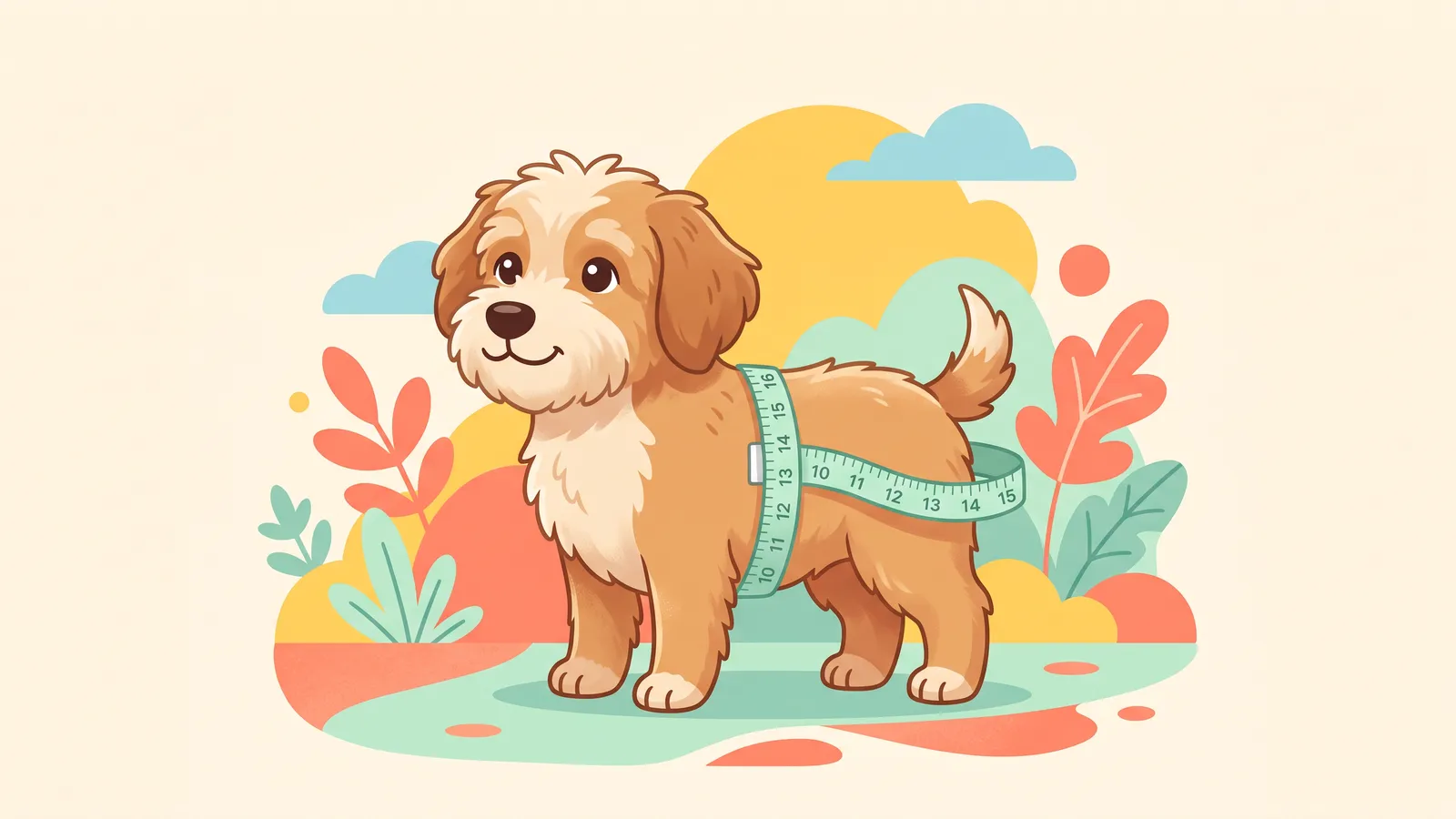
- Measure first. Chest girth at the widest part of the ribcage, about 2 inches behind the front legs, plus the neck. Our guide on how to measure a dog for a harness walks through it with brand size charts.
- Put it on the right way up. Rings face out and the back ring sits on top. See how to put on a dog harness for each style.
- Two-finger check. Two flat fingers under every strap, no more.
- Center the front ring. It should sit on the breastbone, not off to one side or up at the throat.
- Check the armpits. The girth strap should sit a few fingers behind the front legs, not rubbing in the "armpit."
- Walk and recheck. If the front ring slides sideways every time your dog pulls, tighten the girth strap and switch to the back ring until your loose-leash training catches up.
Harness vs collar: puppies, small dogs, large dogs and dachshunds
The supporting questions owners ask most often come down to one rule: clip the leash to a harness, keep the collar for ID tags.
- Puppies: Treeline's trainer says puppies can and should wear harnesses, because a proper fit helps keep them from damaging the neck or trachea.
- Small dogs: a light harness with a back clip, sized from the XXS or XS range rather than squeezed into a bigger one.
- Large dogs: a harness with a front ring gives you control without putting the force on the neck. Train loose-leash walking so you aren't relying on the gear.
- Dachshunds: the Dachshund IVDD group advises a harness rather than a collar for walking.
- Slip leads: a slip lead tightens around the neck when the dog pulls. It's handy for a quick hop from car to door, but for a dog that pulls, a flat-faced dog or a long-backed dog, we'd use a harness instead.
Gear that helps
Ruffwear Front Range Harness
Best two-clip everyday harness. Evidence level: tested by Treeline Review, whose trainer named it best for small dogs and said it fits boxy dogs like Frenchies and pugs well. It has a back V-ring and a reinforced front webbing loop, four adjustment points and foam padding, in girth sizes from XXS (13–17") to L/XL (32–42"). Whole Dog Journal's reviewer noted the small front ring may be a weak point for strong pullers.
2 Hounds Design Freedom No-Pull Harness
Best for strong pullers. Evidence level: tested by Whole Dog Journal, which called it "the easy top choice" in its 2025 no-pull test. It has front and back rings, four adjustment points and velvet lining under the legs. Treeline found the back martingale loop did little, so clip at the front, or use both rings with a double-ended leash.
Blue-9 Buckle-Neck Balance Harness
Best for long backs. Evidence level: specs only. Six adjustment points, including the strap along the back, a Y-shaped chest, front and back rings, and a buckle neck so nothing goes over the head. The first fitting takes a few rounds of adjusting; after that it stays put.
On a budget with a small, square-built dog? The rabbitgoo No-Pull Harness (tested by Treeline Review) has front and back rings and a handle; Treeline found it too short in the back for medium and large dogs.
This guide is general information, not veterinary advice. If you're worried about your dog, talk to your vet. If your dog coughs, gags or breathes noisily on walks, has a long back or a history of back or neck problems, or is a flat-faced breed, ask your vet which harness setup suits them. If a harness leaves red or bald patches, stop using it and get the fit checked.
FAQs
Is a front clip or back clip harness better?
Front clip for a dog who pulls, back clip for a dog who doesn't. If you're not sure, buy a harness with both rings and try each on the same walk route for a week.
Do front-clip harnesses stop pulling?
They make pulling easier to manage by turning your dog toward you, but they don't teach your dog anything. Treeline's trainer notes the harness often rotates when a dog keeps pulling. Training is what changes the habit.
Are front-clip harnesses bad for dogs' shoulders?
The ring isn't the problem; the strap is. Treeline's trainer warns that harnesses cutting across the front of the shoulders restrict movement. A Y-front harness with a front ring leaves the shoulders free.
Can I use both clips at once?
Yes. Treeline's trainer suggests a double-ended leash on the front and back rings to steer a dog more effectively. It's a good setup for big dogs who pull on and off.
Which clip is best for a French bulldog?
Either, as long as it's on a harness that sits on the chest. Treeline's trainer says the Ruffwear Front Range fits Frenchies well. Back clip for calm walks, front clip for training. See our French bulldog harness guide.
Start on the back ring, move to the front when your dog pulls, and spend the walk teaching a loose leash. The ring buys you time; the training does the rest.