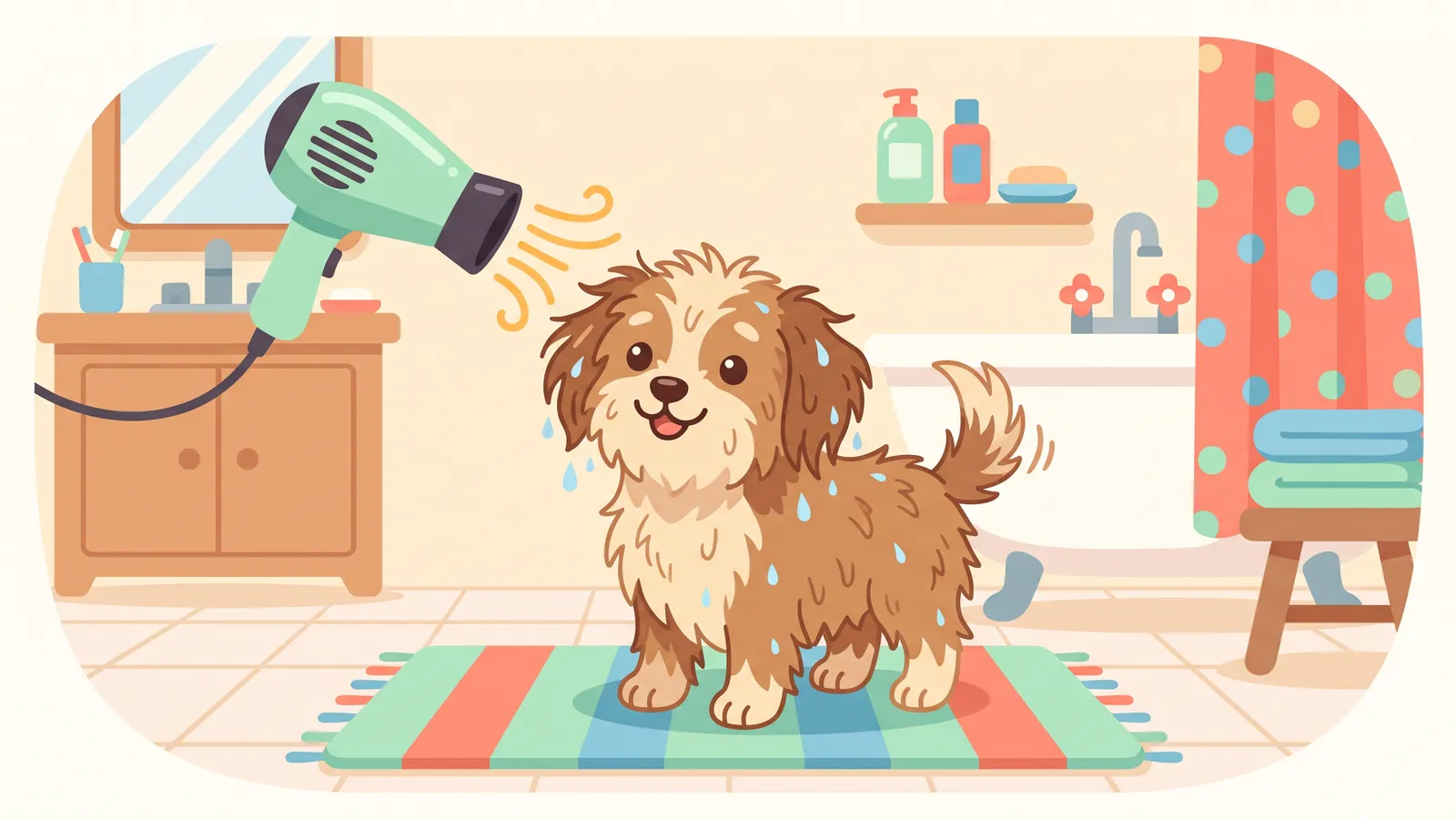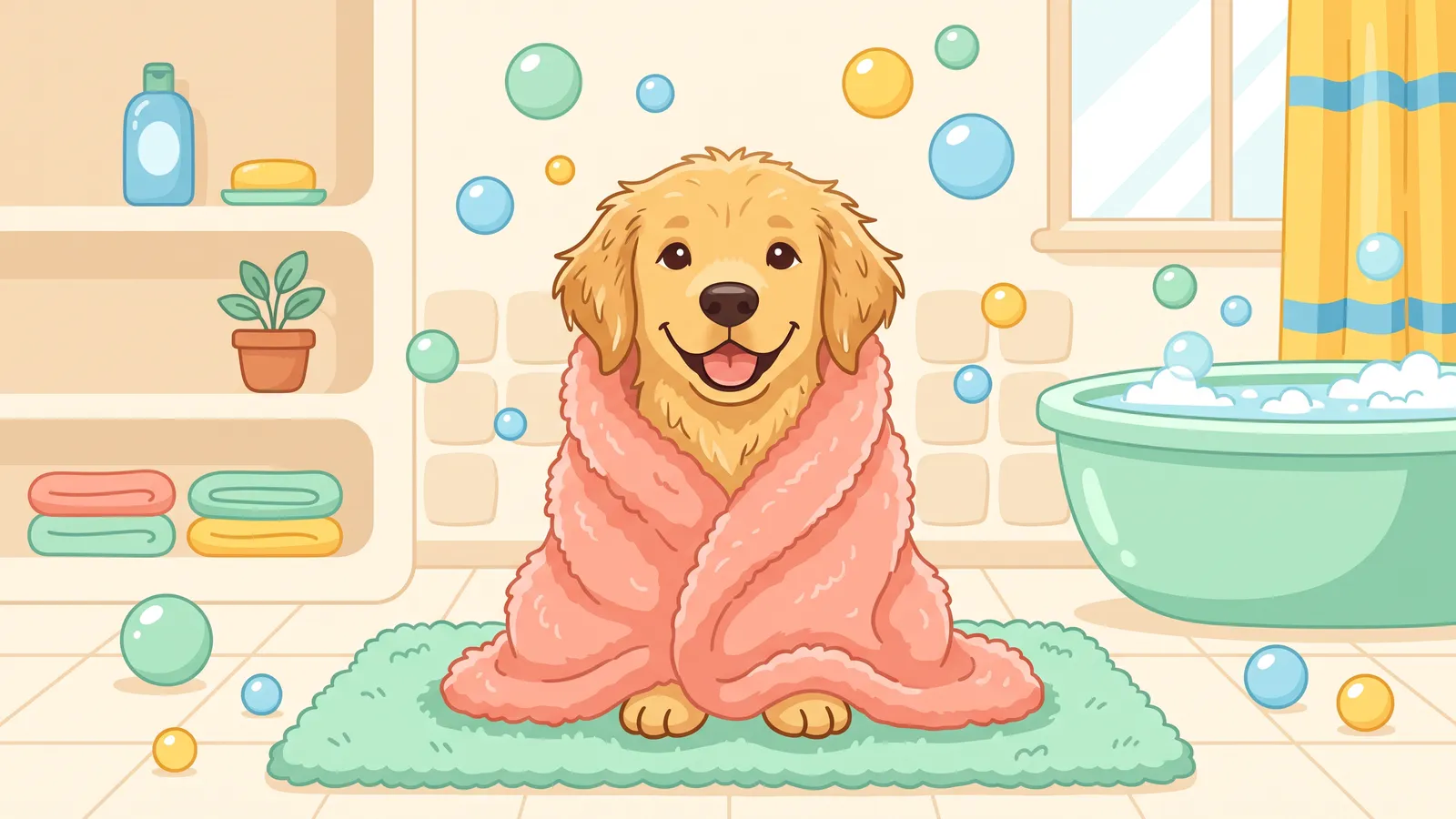
Towel first, then dry. Let your dog shake, then rub them down with two or three towels to get out as much water as you can. If you use a dryer, the AKC says to skip the hottest setting and hold it at least a foot away. Keep the air moving, start on the back legs, keep it off the face and ears, and dry right down to the skin. No dryer? A warm room and more towels do the job; it just takes longer.
Drying is the part of bath day most people rush, and it's the part that matters most for thick coats. A damp undercoat pressed against the skin for hours isn't what you want. Here's the routine from towel to finished coat, with the safety rules for heat and noise.
Step 1: towel off (do this well and everything else is faster)
- Squeeze before you lift your dog out. Run your hands down the legs, body and tail to push water off while they're still in the tub.
- Let them shake. The AKC's bath guide notes your dog will "shake himself off rigorously", so stand back. A towel draped over their back as they shake catches a lot of it.
- Rub down with two or three towels. The AKC says to rub your dog with "a towel, or three" to get them as dry as you can. Swap to a dry towel as soon as the first one is soaked.
- Long or curly coats: press and squeeze. Our take: on a Poodle, doodle or long-haired dog, blot and squeeze sections of coat rather than scrubbing in circles, which can tangle the hair.
- Do the face, ears and paws by hand. Gently dry inside the ear flaps and between the toes with a corner of the towel.
Groomer to Groomer magazine makes the same point for professionals: use absorbent towels to remove as much water as possible, so the dog spends less time under a machine dryer.
Step 2: use the dryer on safe settings
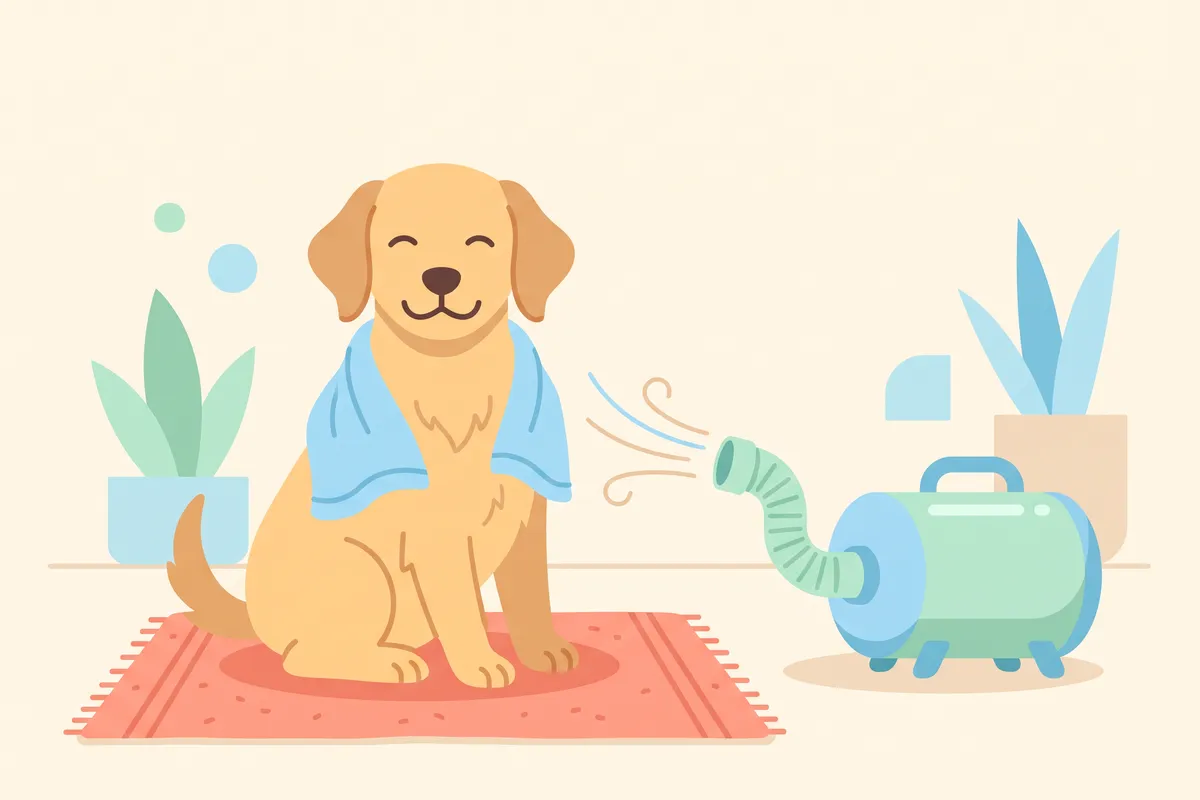
Whole Dog Journal says most dogs don't need a heated dryer. A dog dryer works mainly by pushing water off the coat with air, not by warming it.
| Setting | What to do | Why |
|---|---|---|
| Heat | Off, or the lowest setting | The AKC says skip the hottest setting so you don't burn the skin |
| Distance | At least 12 inches (one foot) away | The AKC's distance rule; closer air concentrates heat on one patch |
| Movement | Keep the nozzle moving | Holding still in one spot is how skin gets too hot |
| Temperature check | Feel the air on your inner wrist every few minutes | If it's hot on you, it's too hot for your dog |
| Speed | Start on the lowest speed | Easier on a nervous dog; go up only once they're settled |
| Where to start | Back legs and rump, then forward | The least sensitive area first |
| Face and ears | Never point the dryer there | Groomer to Groomer warns forced air can injure a pet if blown into the eyes, ears, nose or mouth; use a towel for the head |
A few more habits:
- Cover the ears. Groomers use cotton balls in the ears, a snug fabric ear wrap (often sold as a "Happy Hoodie"), or both. A published study of grooming dryers found they run at roughly 95 to 108 dBA and noted dogs may be easier to handle with their ears covered.
- Stay in the room. Never leave a dog alone with a dryer running, and never close a dog in a crate with a heated dryer blowing in. The Animal Medical Center in New York reports that dogs have died left unattended in hot air-drying cages.
- Dry to the skin on double coats. Part the coat with your fingers. If the undercoat feels cool and damp near the skin, keep going.
Step 3: finish and brush
- Check the "wet spots": behind the ears, the armpits, the belly, the base of the tail and the back of the thighs.
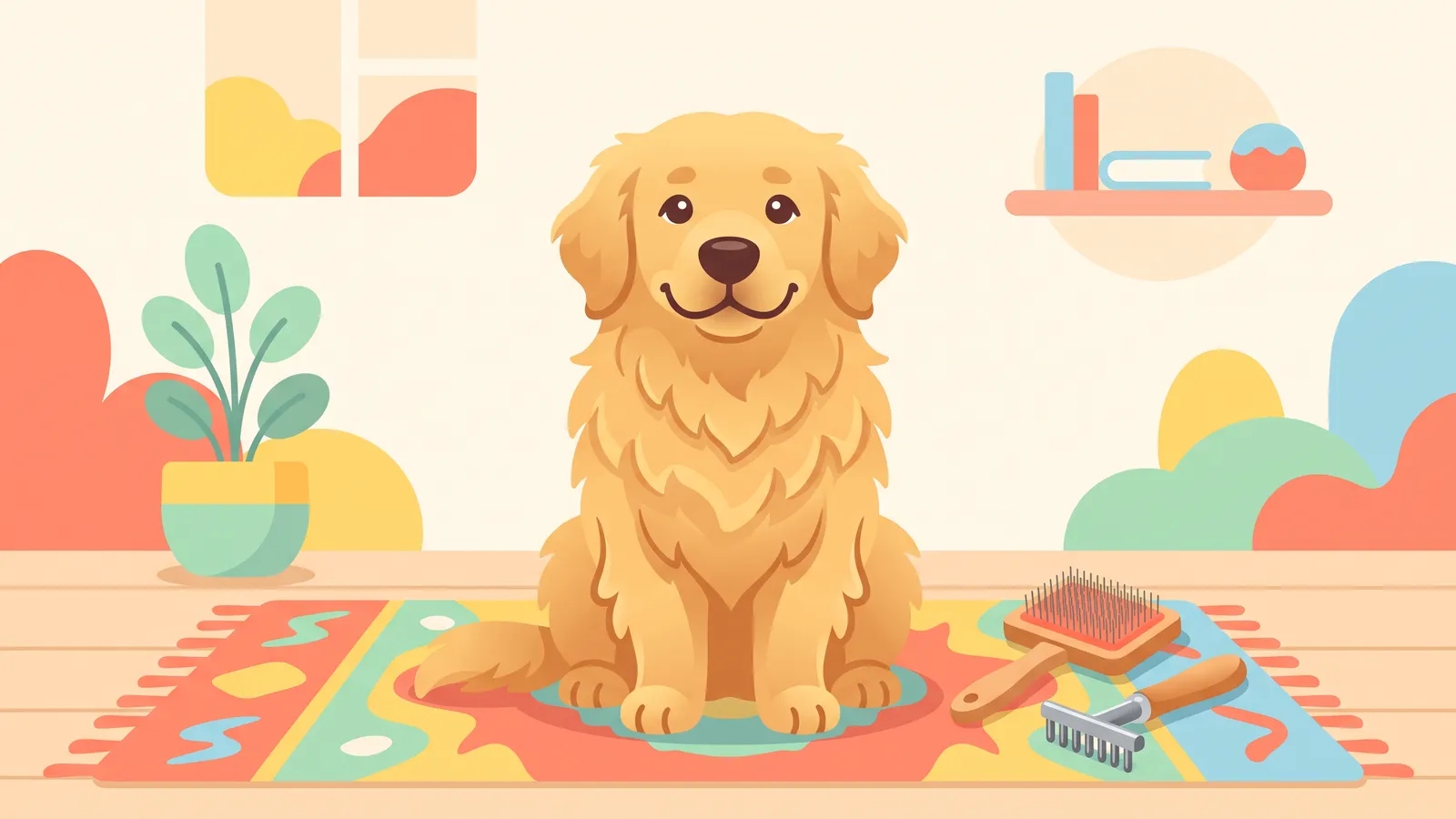
- Brush only when dry. For goldens and Corgis, the AKC says the coat must be completely dry before you brush. On a double coat, a high velocity dryer also blows out a lot of loose undercoat as it dries, which is a bonus during a coat blow.
- Keep them somewhere warm until they're fully dry, especially in winter.
Drying plan by coat type
Our data. This is our summary of the AKC's bath and grooming advice and Whole Dog Journal's dryer tests, matched to coat type.
| Coat | Towel | Dryer | Finish |
|---|---|---|---|
| Short, smooth (Frenchie, Beagle, smooth Chihuahua) | Usually enough on its own | Optional: low speed, no heat | Warm room; dry facial folds on a Frenchie |
| Short double (Lab) | Rub hard, 2–3 towels | Helpful for the undercoat | Brush once dry |
| Medium or long double (golden, shepherd, Corgi, husky) | Squeeze, then rub | High velocity on low heat, to the skin | Dry completely, then brush |
| Curly (Poodle, curly doodle) | Blot and squeeze | High velocity on low speed, then finish with a brush | Comb to the skin once dry |
| Long, silky (long-haired Chihuahua or Dachshund) | Blot and squeeze | Low speed, low or no heat | Comb through |
How to dry a dog without a dryer
Plenty of dogs never see a dryer. Without one:
- Towel thoroughly, swapping to dry towels as you go.
- Put your dog in a warm room until they're completely dry. The AKC suggests a warm, sunny room.
- Move room-temperature air. Groomer to Groomer suggests fans as an alternative to heated dryers for professionals: constant room-temperature air opens the coat and speeds evaporation, as long as the room is warm enough that the dog doesn't get chilled.
- Keep them off the sofa until they're dry, or put a towel down.
- Bathe earlier in the day, especially in cold weather, so a thick-coated dog has hours to dry before evening.
How to dry a dog fast
- Towel longer than feels necessary. Every bit of water you squeeze out is time saved.
- Use a high velocity dog dryer. It blasts water out of the coat. Whole Dog Journal dried a rough Collie in roughly 25 minutes with the fastest dryer it tried, against about an hour with the slowest.
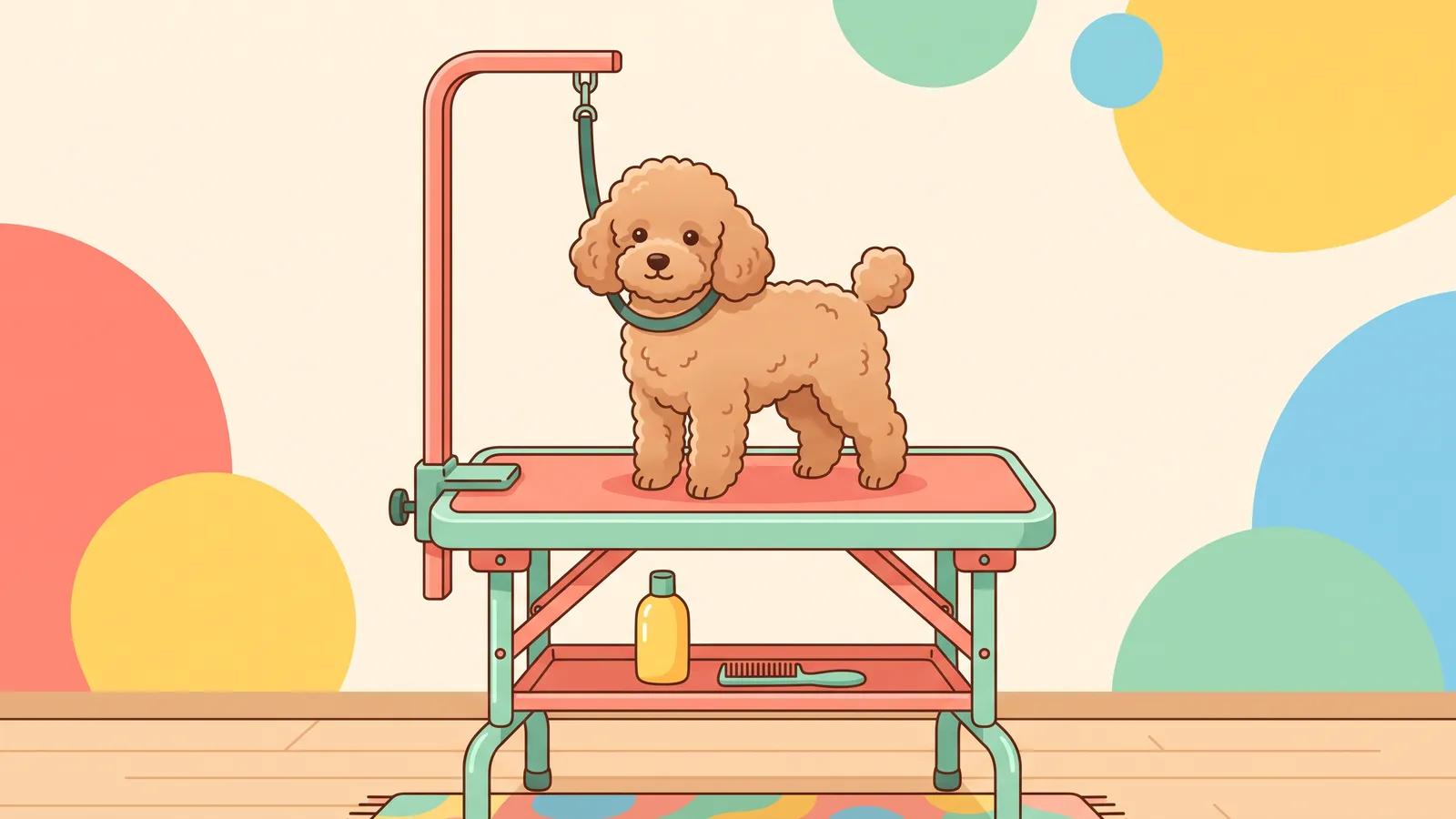
- Use a grooming table. A dog standing still at a comfortable height dries much faster than one wandering the bathroom.
- Drying sprays exist. Groomer to Groomer mentions sprays made to help water run off the hair faster. If you try one, use a product made for dogs.
Can you dry a dog with a human hair dryer?
On a small or short-coated dog, yes, on the cool or lowest setting, held well away and kept moving. Human dryers mostly work by heat, so they're slow on a thick coat and it's easy to overheat one patch of skin. Check the air on your wrist often. For a big double-coated dog, a dog dryer is safer and much faster; see our dog dryer roundup.
How to dry a dog who hates the hair dryer
Go slowly; it's worth it. This is the plan from our dryer guide:
- Days 1–3: turn the dryer on in another room while your dog eats or chews something good. Turn it off before they get worried.
- Next few days: bring it closer, still pointed away, on the lowest speed.
- Then: short puffs of low air on the back legs, with treats, a few seconds at a time.
- Only then: a short real drying session that ends before your dog has had enough.
Whole Dog Journal notes a variable-speed dryer is easier to get a noise-sensitive dog used to, because you can start barely above a whisper. K9 of Mine is blunt: if your dog shows distress, stop. Until they're comfortable, towel and a warm room are fine.
Gear that helps
SHELANDY Dog Grooming Dryer
Best budget dryer. Evidence level: tested by Whole Dog Journal, which named it its best budget dog dryer. It's light, has variable speeds for slow introductions, and the heater is optional. WDJ notes users report it's loud.
Metro Air Force Commander 2-Speed Dryer
No heater at all. Evidence level: tested by Whole Dog Journal, which found it slow on a thick coat (about an hour on its Collie) and didn't recommend it for that job. Metrovac says its dryers have no heating element, which takes burns off the table. A sensible pick for short and medium coats.
Master Equipment Grooming Table with 36" Arm
Saves your back. Evidence level: specs only. PetEdge lists a non-slip rubber top, folding steel legs and a 36" arm, at a fixed height of about 32½". Never leave your dog alone on the table or in the loop. More options in our grooming table roundup.
For big double coats on a dog who doesn't mind noise, Whole Dog Journal's fastest dryer was the Flying Pig Double; WDJ found it large, heavy and loud even on low.
This guide is general information, not veterinary advice. If you're worried about your dog, talk to your vet. Heat: flat-faced breeds like Frenchies and pugs overheat more easily than long-nosed dogs, the Animal Medical Center notes, so keep the heat off and take breaks. Groomer to Groomer says some elderly dogs react badly to high velocity dryers. If your dog is old, anxious, has a heart or breathing problem or is a flat-faced breed, ask your vet before using a dryer, and use towels and a warm room in the meantime. Anxiety: if your dog pants hard, trembles, tries to escape or snaps during drying, stop. Persistent fear of grooming is worth raising with your vet.
FAQs
Is it okay to let my dog air dry?
For short coats, usually yes, in a warm room after a good towel-off. The AKC suggests a warm, sunny room until your dog is completely dry. For thick double coats, a dryer gets the undercoat dry far sooner.
How long does it take a dog to dry after a bath?
It depends on the coat and the method: a towel does most of the work on a short coat, while a thick double coat takes much longer. Whole Dog Journal's Collie took roughly 25 minutes to an hour with a dog dryer.
Should I dry my dog's face with a dryer?
No. Groomer to Groomer warns forced air can injure a pet if blown into the eyes, ears, nose or mouth. Dry the head and ears with a towel.
What temperature should a dog dryer be?
Low, or no heat. The AKC says skip the hottest setting and hold the dryer at least a foot away. If the air feels hot on your wrist, it's too hot.
Can I put my damp dog in their crate to dry?
Only with no heated air blowing in, and with a dry towel or pad. Never close a dog in a crate with a heated dryer; the Animal Medical Center reports dogs have died in hot drying cages.
Towel well, keep the air low and moving, and finish in a warm room. How often you'll be doing this depends on the coat: see how often to bathe a dog.